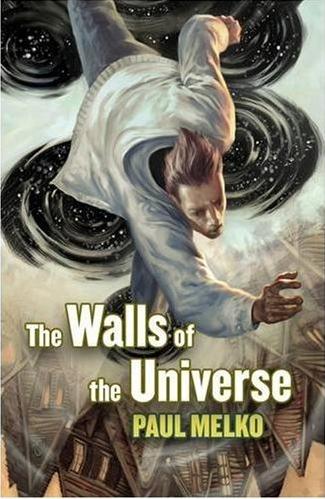
 Welcome to my second interview. Today I’m pestering another local Ohioan, Paul Melko. Paul has written over two dozen short stories and two novels. Singularity’s Ring, his first novel (Tor Books, February 2008) postulates a future of group-conscious humans, telling the tale of one such quintet learning to be a starship pilot. His collection, Ten Sigmas and Other Unliklihoods (Fairwood Press, March 2008) compiles his short science fiction, including the novella “The Walls of the Universe” which was nominated for the Sturgeon, Nebula, and Hugo Awards in 2007. This novella became the basis for his second novel, The Walls of the Universe (Tor Books, February 2009) which is the inspiration for this interview:
GW: You made extensive use of Ohio locations in The Walls of the Universe, did you choose it because you’re a resident, or is there more to that decision?
Wherever I live, the locations become settings for my stories. When I lived in Pittsburgh, alien ships hovered over the south hills and a desk made from irradiated metal was used to kill a dot-com start-up executive from Carnegie Mellon. When I lived in Ann Arbor, a professor’s murder was solved there with the use of an aromatic forensic device that detects everything that happens in a room. When I lived in Chicago, a girl-band lead singer from the Loop saved the world from extremely slow aliens. When I lived in Ohio, a depressed superhero turned all of Ohio (and some of Indiana) into the Socialist Buckeye Republic, and a Volkswagen Beetle crashed into the Olentangy River not far from where I lived.
Of course those things all happened in my head, but the settings were real. The Walls of the Universe is set in Findlay and Toledo, but across multiple parallel universes. In fact my protagonist visits a hundred Ohios in the book, including a Pleistocene universe in which megafauna still walk the plains below Lake Erie. Ultimately the back story will reveal the significance of the Serpent Mound and other prehistoric artifacts of Ohio. But really, I chose Ohio because I love Ohio and I am a Ohioan from birth.
GW: How do you think it changes and/or informs a work when it’s set in a place around where you lived, as opposed to someplace only visited or researched?
Setting a story in a location that the author knows well allows a depth of visualization that otherwise is hard to achieve. I know the pattern of mud that swirls up when you wade into the Olentangy River below the dam. I know the types of spiders that spin webs in the corn fields near Findlay, Ohio. I know what riding the Incline in Pittsburgh feels like. All of that informs the story, adds authenticity and verisimilitude.
Which is not to say that a researched locale can’t be as real to the reader. Singularity’s Ring leads the protagonist up a space elevator to GEO and down again, through the Amazon rain forest, the Rocky Mountains, and up a desiccated Congo. I rely on experience and imagination to depict those things for my readers.
GW: Sometimes authors refer to the setting as an additional character in the story, what’s your take on that? Is that a good thing or a bad thing?
I’ve heard that expression and it’s always puzzled me. Characters are characters and setting is setting, and unless you’re dealing with a sentient house, I can’t see how treating setting as a character is anything other than another metaphorical tool. Perhaps I’ll use it one day….
GW: Do you think it’s more difficult or easier writing about someplace you’re familiar with (or its analog) than it is writing about someplace out of whole cloth?
There are benefits to both. A real place may constrain your imagination, while a fabricated location can have any detail or facet that you can accurately describe. On the other hand, as I’ve said above, a real place can be used to enhance verisimilitude, while an imagined place may not pull the reader in as well. I of course use both types of settings; creating imagined settings is a key skill for a science fiction writer!
GW: What led to your decision to set The Walls of the Universe in Ohio, was it part of the original story idea, or did it come later? What do you think the setting contributes to the book?
The main character lives in a town very like the town I lived in as a youth. Part of the story deals with slightly different versions of that same town. So I felt that having a detailed knowledge of the locale would make it easier to vary it from universe to universe.
Plus, there isn’t enough science fiction set in Ohio! But really, why not? I love Ohio and love writing stories set there
You can find Sample chapters from The Walls of the Universe on Paul Melko’s website.
